Abstract
The phenology of the flora of the Ecological Reserve of Ñacuñán was recorded, located in the center of the Phytogeographical Province of Monte, in Santa Rosa, Mendoza. It has a semi-arid climate with an average rainfall of 310 mm/year, with a markedly summer distribution. The soil is sandy to sandy- loam. The objective was to determine a phenological pattern of growth and development stages that would include the largest number of species in the Monte community. After 54 years of closure, with monthly observations over five vegetative cycles (1979-1984), the stages of vegetative growth, flowering, fruiting, fruit maturation, or spiking were recorded for 106 species. On an observation trail, each species had a minimum of 10 observation specimens; when 50% showed signs of growth or development, the corresponding stage was recorded. There were 41 herbaceous species, including grasses. 36 of them are perennial grasses, 25 are woody, and 4 are succulent. 36.8% of the species manifest growth and development during the late spring, summer, and autumn months, coinciding with the concentration of rainfall.
Keywords
Phenology, Vegetative Growth, Flowering, Fruiting
1. Introduction
The vascular flora of the Ñacuñán Reserve was originally described by Roig, who identified 122 taxa, with dominance of
Larrea cuneifolia shrublands and open woodlands of
Neltuma flexuosa | [1] | Roig, Fidel Antonio, 1971. Flora and Vegetation of the Ñacuñán Forest Reserve. The vegetation. Deserta, 1: 201-239. |
[1]
. Following the establishment of perimeter fencing in 1972, the area was excluded from grazing, allowing significant vegetation recovery. Subsequent evaluations after 25 years of exclusion reported no substantial increase in species richness, although several new taxa were detected in specific microhabitats. Eleocharis macrostachya, Hordeum stenostachys, Melilotus albus, Avena barbata, Gnaphalium gaudichaudianum, Lepidium spicatum, Glandularia flava
| [2] | Rossi, Bertilde Elda, 2004. Flora and vegetation of the Ñacuñán Biosphere Reserve after 25 years of closure. Spatial heterogeneity at different scales. Doctoral Thesis. Page 151. Postgraduate Studies in Biology, National University of Cuyo. |
[2]
.
Plant phenology refers to the periodic production of vegetative and reproductive structures resulting from interactions between biotic and abiotic factors that regulate the timing of growth and reproduction
| [3] | Van Schaik, Carel. P., John. W. Terborgh, and S. Joseph. Wright, 1993. The phenology of tropical forests: Adaptive significance and consequences for primary consumers. Annu. Rev. Ecol. Syst. 24: 353-377. |
[3]
. It constitutes the study of recurring life-cycle events and their environmental controls
| [4] | Volpe, C. A. 1992. Citrus Phenology. In: Proceedings of the Second International Seminar on Cítrus Physiology, |
[4]
. Seasonal sequences can therefore be identified in relation to climate, vegetative dormancy, growth activity, flowering, and fruiting
| [5] | Bradley, Nina. L., A. Carl. Leopold, J. Ross, and Wellington. Huffaker. 1999. Phenological changes reflect climate change in Wisconsin. Proc. Natl. Acad. Sci. USA 96: 9701-9704. |
[5]
.
Climate change is currently altering phenological patterns worldwide; however, generalized models explaining rates and mechanisms of phenological shifts across spatial and temporal scales remain limited
| [6] | Robert Guralnick, Theresa Crimmins, Erin Grady & Lindsay Campbell, 2024 Phenological response to climatic change depends on spring warming velocity. Communications earth & Environment.
https://doi.org/10.1038/s43247-024-01807-8 |
[6]
. In eastern Mendoza, long-term meteorological records (1919–2004) indicate an average annual precipitation of approximately 310 mm, with only five years registering values below 150 mm. Although projections suggest potential increases in rainfall in the plains, no clear floristic shifts have yet been documented in the reserve
| [7] | Ricardo Villalba y Daiana Woutees, 2022. Changes in rainfall patterns in eastern Mendoza and how they affect cultivated areas. IANIGLA - CONICET. |
[7]
. For a meteorological record of 86 continuous years in Ñacuñan (Years 1919-2004), with an annual average of 310 mm/year, there were only 5 cases of average precipitation below 150 mm/year (Year 1923: 108 mm, Year 1924: 147.1, Year 1935: 134.5 mm, Year 1948: 116 mm and 2003: 90.8 mm) that is, a marked decrease in precipitation below the annual average, of close to 6%
| [8] | Ñacuñan Meteorological Station (1919 - 2004) IADIZA. |
[8]
. If we consider that rainfall in the plains is going to increase, some floristic changes may occur in the reserve, which are not currently observed.
Phenology is a fundamental component of the plant “regeneration niche” and plays a central role in species coexistence within plant communities
| [9] | Grubb, P. J. 1977. The maintenance of species richness in plant communities: the importance of the regeneration niche. Review 52: 107-145. |
[9]
. Phenological knowledge contributes to ecological characterization, grazing management, agricultural decision-making, and understanding plant–animal interactions such as pollination and herbivory. Given the high interspecific variability and microhabitat influence on phenological expression, long-term systematic observations are essential. Having phenological knowledge of the vegetation contributes to characterizing plant species and their variations through ecotypes, improves decision-making for livestock management of fields, and in agriculture leads to detecting the different most appropriate stages of cultivation, the dynamics of faunal movements, identifying changes in vegetation in relation to climate modifications
| [10] | Climate Change 1992, editado por IPCC de OMM/PNUMA. -Cambridge University Press, 200 pages. |
[10]
. It is known that the incidence and intensity of vegetation flowering selectively modulates variables such as the abundance of fauna (pollinators and their predators), as well as intra- and interspecific competition of insects for pollen and nectar
| [11] | Leon de la Luz, Jose Luis, Rocio Coria Benet y Minerva Cruz Estrada, 1996. Floral Phenology of an Arid-Tropical Community of Baja California Sur, Mexico. Acta Botánica Mexicana 35: 45-64. |
[11]
.
There is great phenological variability, which may be due to the particular responses of the species that make up the community and depending on how they are in certain microhábitats
| [12] | Williams Guadalupe y Jorge Meave Linera, 2015. Phenological Patterns. Chapter 17. Pages 401-431. |
[12]
. This forces us to select areas where it is possible to observe a certain number of specimens per species. In general, an ideal calendar that signals seasonal changes and plant development requires long-term observations of phenological events, along with concise microenvironmental measurement
| [13] | Alcantara, R. A. 1987. Phenology and Seasonal Changes. Free translation of Phenology and Seasonal Changes. Class notes for Agricultural Phenology and Agrometeorology, Chapingo, Mexico. |
[13]
.
In the Eastern Plain of Mendoza, a bioclimatic map has been prepared based on foliar phenology using satellite images, differentiating the degrees of aridity of this region. The distribution of rainfall determines the geographical distribution of plant communities
| [14] | Gonzalez Loyarte, Margarita. M., Massimo Menenti y Angela Magdalena Diblasi, 2009. Bioclimatic map for the Mendoza Crossings (Argentina) based on leaf phenology. Rev. FCA UNCuyo. Volume XLI. No. 1. 105-122. |
[14]
.
The objective of this study was to qualitatively evaluate the phenological behavior of the entire vascular flora of Ñacuñán over five consecutive years, identifying general patterns and species-specific dynamics.
Working hypothesis:
1) The plant community exhibits definable species-specific phenological patterns.
2) The tree stratum, particularly Neltuma flexuosa, displays phenological behavior partially independent of short-term precipitation variability.
2. Materials and Methods
2.1. Study Area
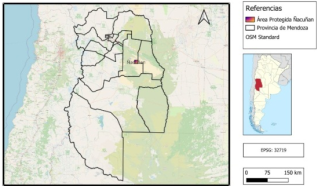
The Ñacuñán Biosphere Reserve is located in the Santa Rosa Department, Mendoza Province, Argentina (34°03′S; 67°58′W), at approximately 540 m a.s.l., covering 12,300 ha. Established in 1971 and incorporated into the UNESCO MAB Network in 1986, the reserve represents the Central Monte phytogeographic province (
Figure 1). Its geographical coordinates are: 34°03'S and 67°58'W. It was created in 1971 and is representative of Monte Central. It emerged as a Forest Reserve and became part of the UNESCO MAB Network in 1986 and its main objective was to protect the carob forest and conserve the soil and the native plant and animal species in natural conditions
| [15] | Claver, Silvia & Roig-Juñent, Sergio. A., Eds (2001). The Monte Desert: The Ñacuñán Biosphere Reserve. Mendoza: IADIZA - MAB - UNESCO. 226 pp. |
[15]
.
It has a semi-arid climate with an average precipitation of 310 mm/year, with a markedly summer distribution
| [15] | Claver, Silvia & Roig-Juñent, Sergio. A., Eds (2001). The Monte Desert: The Ñacuñán Biosphere Reserve. Mendoza: IADIZA - MAB - UNESCO. 226 pp. |
[15]
. Belonging to the Llanura de la Travesia, the soils are very deep, originating from recent sedimentary materials, with a sandy to sandy loam texture with variations in the different plant communities
| [16] | Tanquilevich, Ricardo F., 1971. The soils of the Ñacuñan Ecological Reserve. Pages 131-206. Deserta II. Annals of the Institute of Research of Arid and Semi-Arid Zones. Contributions to the Inventory of Renewable Natural Resources of the Province of Mendoza. |
[16]
.
Figure 1. Location of the Ñacuñán Ecological Reserve, Santa Rosa Department, Mendoza, Argentina.
The observation of the phenological phases of the vascular flora was carried out with monthly visits to the Ñacuñán Reserve for five years (1979-1984), which were part of other research projects. To record the species, two circuits were created with a length of approximately 500 m: one in the South field of the Reserve and the other in the North field. This allowed, through a trail, the observation and recording of the species in a number of no less than 10 specimens of each one. As the observations were monthly, two stages were recorded:
1. Vegetative growth.
2. Reproductive phase, including flowering (or panicles in Poaceae), fruit development, maturation, and seed persistence.
The vegetative state is the active growth phase, while the reproductive phase includes flowering in broadleaf and woody plants or panicles of grasses, with the emission and opening of the flowers or anthesis of the grasses until their maturation and the permanence of the seeds in the inflorescences or panicles and spikes.
The frequency of observation did not allow establishing differences between the flowering, fruiting and fruit release phase, so a continuum of these stages was recorded.
When at least 50% of the specific specimens showed the expression of growth, flowering or fruiting, the beginning and end of the phenological stage was considered.
At all times, the measurement of species in different sites was avoided, such as depressions or under the tree canopy of carob and chanar trees, where they manifested a different phenology, either earlier or more persistent. For this reason, the evaluation was always located in the same site under the conditions of the jarillal community of L. cuneifolia and L. divaricata, with or without direct sunlight according to the requirements of the species. During the route of field N, a sector of dunes was included for psamophilous species.
Of the total Flora of Ñacuñán, the following species were not recorded:
Bromus catharticus, Senna aphylla, Habranthus jamesonii, Rhodophiala mendocina, Polygala stenophylla, Parietaria debilis, Lycium chilense var. petiolatum. Among the naturalized exotics: Sonchus oleraceus, Salsola kali, Bassia scoparia, they were excluded from the analysis due to their low presence or sporadic occurrence.
3. Results and Discussion
A total of 106 species and varieties were recorded: 41 annual herbaceous species, 36 perennial herbaceous species, 25 woody species, and 4 succulents. Annexes [
Figure S1,
Figure S2,
Figure S3,
Figure S4,
Figure S5,
Figure S6,
Figure S7].
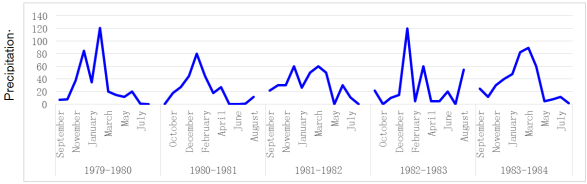
The precipitation of the place during the years of observation
| [8] | Ñacuñan Meteorological Station (1919 - 2004) IADIZA. |
[8]
is seen in
Figure 2.
Figure 2. Precipitation record from the Ñacuñán Meteorological Station (ÑME) during the cycles 1979-80 (355.6 mm), 1980-81 (265.2 mm), 1981-82 (369.8 mm), 1982-83 (304.6 mm) and 1983-84 (410.0 mm).
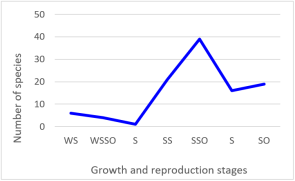
Across the five-year period, 36.8% of species exhibited vegetative growth and reproductive activity from late spring through autumn, coinciding with the seasonal precipitation peak. Additional groups showed spring–summer (19.8%), summer–autumn (17.9%), or strictly summer (15.1%) phenological patterns (
Figure 3).
Attempts to correlate phenophase onset with precipitation events were inconclusive due to spatial variability in rainfall distribution relative to the meteorological station.
Figure 3. Manifestation of growth and reproduction of the Ñacuñán vegetation WS: winter-spring; WSSO: winter-spring-summer-autumn; S: spring; SS: spring-summer; SSO: spring-summer-autumn; S: summer and SO: summer-autumn.
Braun Rolando et al. carried out for three years a synthesis of phenological observations of some woody and herbaceous species, of the latter mainly grasses. The recorded species behaved like summer manifestations
| [26] | Nakamatsu, Viviana. B. 1987. Shrubs of Patagonia. Yaoyin or Llaollin. Presence, (11). |
[26].
Neltuma flexuosa exhibited a remarkably stable phenological cycle. Leaf emergence typically began in mid-October, immediately followed by flowering. Fruit maturation occurred between January and February, with occasional persistence into March–April. Interannual variation in vegetative onset was limited to 1–3 weeks. This species behaves as a phreatophytic or vadose-zone exploiting tree, accessing subsurface moisture retained in clay–sandy lenses. Its phenological cycle appears largely independent of short-term rainfall pulses
| [17] | Roig, Fidel Antonio, 1985. Trees and forests of the Central Western Arid Region of Argentina (Provinces of Mendoza and San Juan) and their silvicultural possibilities. Proceedings of Afforestation in Arid and Semi-arid Zones, Second Regional Meeting C. I. I. D. Latin America and the Caribbean, 145-188. Santiago, Chile, May 13-17. |
| [18] | Cavagnaro, Juan Bruno. y Carlos Bernardo Passera. 1993. Water relations of Prosopis flexuosa (sweet carob) in the Monte, Argentina. In: IADIZA (Eds). 1993. Conservation and improvement of species of the genus Prosopis, 73-78. Mendoza, Argentina. 153 pp. |
[17, 18]
. Leaf senescence contributes significantly to litter accumulation and nutrient cycling, improving soil nitrogen availability beneath the canopy and favoring the natural establishment of grasses and herbaceous plants
| [19] | Parizek Bernarlo, María de la Reta, Leonor Ana Catalán, Mónica Balzarini y Ulf Ola Karlin, 2000. Phenological observations of the black carob (Prosopis flexuosa D. C.) and the white carob (Prosopis chilensis (Mol.) Stuntz) in the Arid Chaco, Argentina. MULTEQUINA 9: 135-146. |
[19].
When foliation begins, the specimens were always without leaves from the previous year, probably for temperature reasons. This differentiates it from the behavior observed in Chancani, Cordoba
| [20] | Duke, Norte Carolina, 1990. Phenological trends with latitude in the mangrove tree Avicenia marina. J. Ecol. 78: 113-133. |
[20]
., where 40% of the trees still have a remnant of foliation. A plant may possess more than one phenological state at a given time, depending on the timing of its reproductive activity
| [21] | Karlin, Ulf Ola. & Raul Osvaldo Díaz, 1984. Potential and management of carob trees in the arid subtropical regions of Argentina. SECYT, National Program of Renewable Natural Resources Vol. I: 59 pp. |
[21]
. Specimens of N. flexuosa were also observed in incipient flowering stages when others were in advanced fruiting.
It is known that in our country, the probability of obtaining a greater quantity of fruits increases the drier and warmer the environment is at the time of flowering. Furthermore, the species behaves like a “vecera” with years of high and low production. Sometimes the occurrence of hail in the area leads to great loss of fruits
| [22] | Monasterio, Maximina and Guillermo Sarmiento, G., 1976. Phenological strategies of plants species in the tropical savanna and semideciduous forest of Venezuelan Llanos J. Biog. 3: 325-356. |
[22]
.
Annual herbs responded rapidly to winter–spring rainfall and maintained reproductive activity through summer depending on moisture availability, while for forest vegetation, maximum flowering and fruiting occurs during the dry period
| [23] | Ramirez, Nelson., 2002. Reproductive phenology, life-forms, and habitats of a Venezuelan Central Plain. Amer. J. Bot. 89: 836842. |
| [24] | Eduardo Martinez Carretero & Antonio Daniel Dalmasso, 1992. Litter yield in shrubs of Larrea in the andean piedmont of Mendoza, Argentina. Vegetatio 101: 21- 33, Kluwer Academic Publishers, Printed in Belgium. |
[23, 24]
.
Atriplex lampa begins early flowering in the month of September and concentrates ripening in the month of December. It may show vegetative growth during summer and fall, sometimes also some growth in early winter.
Atamisquea emarginata, an evergreen species, shows periods of growth and reproduction in spring, summer and autumn, with foliar loss during the winter.
Evergreen species such as Larrea divaricata and L. cuneifolia showed a vegetative and productive behavior similar to a piedmont in the Luján de Cuyo department, with lower precipitation levels, of 220 mm/year
| [25] | Braun, Rolando H., Roberto Juan Candia, R. Leiva, Mario N. Páez, Carlos R. Stasi y Carlos F. Willoud, 1978. Net Primary Aboveground Productivity of the Algarrobal de Ñacuñán (Mendoza). Deserta 5. Contributions of the Argentine Institute of Arid Zone Research. IADIZA. |
[25]
.
Among herbaceous perennials, Sphaeralcea miniata manifests itself with reproductive phenology during the spring, summer and autumn seasons; no fruiting was observed during the winter period. Another observer recorded winter behavior for S. miniata when precipitation conditions are favorable
| [26] | Nakamatsu, Viviana. B. 1987. Shrubs of Patagonia. Yaoyin or Llaollin. Presence, (11). |
[26]
. During the five years of observation, only a brief vegetative manifestation was recorded in the month of June.
Winters are generally dry, this makes species like Panicum urvilleanum behave like spring-summer-autumn. However, this species in Payunia, Malargüe, grows at any time of the year when it has moisture, with a preference for gleaning in spring-summer (personal obs.). Something similar happens with Lycium spp. that grows, flowers and bears fruit all year round if they have moisture
| [27] | Dalmasso, Antonio Daniel, Roberto J. Candia y Carmelo Ganci, 2008. Xeriscaping with native species. Scientific Extension Bulletin. Argentine Institute of Arid Zone Research. |
| [28] | Juan Bruno Cavagnaro y Carlos B. Passera, 1993. Water relations of Prosopis flexuosa (sweet mesquite) in the Monte region of Argentina. Contributions from Mendoza to the Fifth Regional Meeting for Latin America and the Caribbean of the CIID Forestry Network. Conservation and improvement of the genus Prosopis. IADIZA-CRICYT-CIID, Mendoza, Argentina. |
[27, 28]
.
If there is precipitation in spring and summer, almost all of the grasses are available.
The presence of Salsola Kali has advanced in recent years on disturbed land, edges and centers of roads and footprints, with ingressions on the margins of the jarilla communities.
Perennial grasses (mostly C4 species) responded speedily to spring–summer precipitation. Certain species (e.g., Nassella tenuis) exhibited marked interannual population fluctuations. Introduced species such as Eragrostis lehmanniana and Bromus catharticus showed opportunistic behavior linked to wetter years.
Bromus catharticus was recorded as present in rainy years and in dry periods it is not observed, so it is deduced that it behaves as a falsely perennial.
Eragrostis lehmanniana, introduced in the Reserve, manifests itself in years with average rainfall, however, in dry seasons it is not observed, remaining in the seed bank that is expressed when precipitation conditions improve.
Winter-active species such as Schismus barbatus (exotic naturalized) were consistently present despite limited winter rainfall.
All succulent species displayed a single annual reproductive period, peaking during summer.
We worked with almost all the plant species present. This allowed us to understand the phenological spectrum over the 5 years of observation. Based on these measurements, future research will require working with a smaller number of species considered valuable, preferably with phenological records in relation to rainfall.
In previous observations in the Monte province, the phenological manifestation of N. flexuosa has been discussed as independent of rainfall. Carob trees normally complete their phenological stages, even during periods when the upper soil layers are very dehydrated
| [29] | Dalmasso, Antonio Daniel, 1994. Phenology of five native grasses of forage interest. Pappophorum caespitosum, Trichloris crinita, Setaria leuco-pila, Digitaria californica and Diplachne dubia. Multequina 3: 9-34. |
[29]
. It was found that the records over the 5 years show that the delay in the onset of vegetative growth only varied by 1 to 3 weeks between years.
4. Conclusions
The majority of species concentrate vegetative and reproductive activity between late spring and autumn, coinciding with the seasonal precipitation regime.
Annual herbaceous species respond rapidly to rainfall pulses and maintain extended reproductive phases during favorable summers.
Climbing perennial herbs exhibit growth in response to rainfall pulses, primarily during the summer.
Perennial grasses (predominantly C4) depend strongly on spring–summer precipitation. C3 plants, such as Jarava ichu, show early spring growth
.
Shrubs initiate growth early in spring, even under low rainfall conditions. They exhibit different behaviors; for example, Atriplex lampa, with scarce spring rainfall, vegetates and fruits in November and December of each year, releasing bracts, and by January, the plants do not yet have seeds.
Neltuma flexuosa demonstrates a relatively stable phenological cycle with limited interannual variation, largely independent of short-term rainfall fluctuations, begins to grow in October, and flowering and fruiting extend, with variations between individuals, until February sometimes reaching early March.
Bulnesia retama and Geoffroea decorticans respond to spring and summer rainfall.
The five-year continuous dataset provides a comprehensive phenological spectrum for the Monte ecosystem and establishes a baseline for future quantitative studies examining rainfall–phenology relationships under climate change scena- rios.
Abbreviations
IADIZA | Argentine Institute for Arid Zone Research |
CONICET | National Council for Scientific and Technical Research, Argentina |
UNCUYO | National University of Cuyo |
ÑME | Ñacuñán Meteorological Station |
WS | Winter- Spring |
WSSO | Winter- Spring- Summer- Autumn |
S | Spring |
SS | Spring- Summer |
SSO | Spring- Summer- Autumn |
S | Summer |
SO | Summer- Autumn |
Acknowledgments
To the Geobotany partner for their collaborations during the field works.
Author Contributions
Antonio Daniel Dalmasso: Conceptualization, Data curation, Formal Analysis, Funding acquisition, Investigation, Methodology, Project administration, Resources, Software, Supervision, Validation, Visualization, Writing – original draft, Writing – review & editing
Conflicts of Interest
The author declares no conflicts of interest.
References
| [1] |
Roig, Fidel Antonio, 1971. Flora and Vegetation of the Ñacuñán Forest Reserve. The vegetation. Deserta, 1: 201-239.
|
| [2] |
Rossi, Bertilde Elda, 2004. Flora and vegetation of the Ñacuñán Biosphere Reserve after 25 years of closure. Spatial heterogeneity at different scales. Doctoral Thesis. Page 151. Postgraduate Studies in Biology, National University of Cuyo.
|
| [3] |
Van Schaik, Carel. P., John. W. Terborgh, and S. Joseph. Wright, 1993. The phenology of tropical forests: Adaptive significance and consequences for primary consumers. Annu. Rev. Ecol. Syst. 24: 353-377.
|
| [4] |
Volpe, C. A. 1992. Citrus Phenology. In: Proceedings of the Second International Seminar on Cítrus Physiology,
|
| [5] |
Bradley, Nina. L., A. Carl. Leopold, J. Ross, and Wellington. Huffaker. 1999. Phenological changes reflect climate change in Wisconsin. Proc. Natl. Acad. Sci. USA 96: 9701-9704.
|
| [6] |
Robert Guralnick, Theresa Crimmins, Erin Grady & Lindsay Campbell, 2024 Phenological response to climatic change depends on spring warming velocity. Communications earth & Environment.
https://doi.org/10.1038/s43247-024-01807-8
|
| [7] |
Ricardo Villalba y Daiana Woutees, 2022. Changes in rainfall patterns in eastern Mendoza and how they affect cultivated areas. IANIGLA - CONICET.
|
| [8] |
Ñacuñan Meteorological Station (1919 - 2004) IADIZA.
|
| [9] |
Grubb, P. J. 1977. The maintenance of species richness in plant communities: the importance of the regeneration niche. Review 52: 107-145.
|
| [10] |
Climate Change 1992, editado por IPCC de OMM/PNUMA. -Cambridge University Press, 200 pages.
|
| [11] |
Leon de la Luz, Jose Luis, Rocio Coria Benet y Minerva Cruz Estrada, 1996. Floral Phenology of an Arid-Tropical Community of Baja California Sur, Mexico. Acta Botánica Mexicana 35: 45-64.
|
| [12] |
Williams Guadalupe y Jorge Meave Linera, 2015. Phenological Patterns. Chapter 17. Pages 401-431.
|
| [13] |
Alcantara, R. A. 1987. Phenology and Seasonal Changes. Free translation of Phenology and Seasonal Changes. Class notes for Agricultural Phenology and Agrometeorology, Chapingo, Mexico.
|
| [14] |
Gonzalez Loyarte, Margarita. M., Massimo Menenti y Angela Magdalena Diblasi, 2009. Bioclimatic map for the Mendoza Crossings (Argentina) based on leaf phenology. Rev. FCA UNCuyo. Volume XLI. No. 1. 105-122.
|
| [15] |
Claver, Silvia & Roig-Juñent, Sergio. A., Eds (2001). The Monte Desert: The Ñacuñán Biosphere Reserve. Mendoza: IADIZA - MAB - UNESCO. 226 pp.
|
| [16] |
Tanquilevich, Ricardo F., 1971. The soils of the Ñacuñan Ecological Reserve. Pages 131-206. Deserta II. Annals of the Institute of Research of Arid and Semi-Arid Zones. Contributions to the Inventory of Renewable Natural Resources of the Province of Mendoza.
|
| [17] |
Roig, Fidel Antonio, 1985. Trees and forests of the Central Western Arid Region of Argentina (Provinces of Mendoza and San Juan) and their silvicultural possibilities. Proceedings of Afforestation in Arid and Semi-arid Zones, Second Regional Meeting C. I. I. D. Latin America and the Caribbean, 145-188. Santiago, Chile, May 13-17.
|
| [18] |
Cavagnaro, Juan Bruno. y Carlos Bernardo Passera. 1993. Water relations of Prosopis flexuosa (sweet carob) in the Monte, Argentina. In: IADIZA (Eds). 1993. Conservation and improvement of species of the genus Prosopis, 73-78. Mendoza, Argentina. 153 pp.
|
| [19] |
Parizek Bernarlo, María de la Reta, Leonor Ana Catalán, Mónica Balzarini y Ulf Ola Karlin, 2000. Phenological observations of the black carob (Prosopis flexuosa D. C.) and the white carob (Prosopis chilensis (Mol.) Stuntz) in the Arid Chaco, Argentina. MULTEQUINA 9: 135-146.
|
| [20] |
Duke, Norte Carolina, 1990. Phenological trends with latitude in the mangrove tree Avicenia marina. J. Ecol. 78: 113-133.
|
| [21] |
Karlin, Ulf Ola. & Raul Osvaldo Díaz, 1984. Potential and management of carob trees in the arid subtropical regions of Argentina. SECYT, National Program of Renewable Natural Resources Vol. I: 59 pp.
|
| [22] |
Monasterio, Maximina and Guillermo Sarmiento, G., 1976. Phenological strategies of plants species in the tropical savanna and semideciduous forest of Venezuelan Llanos J. Biog. 3: 325-356.
|
| [23] |
Ramirez, Nelson., 2002. Reproductive phenology, life-forms, and habitats of a Venezuelan Central Plain. Amer. J. Bot. 89: 836842.
|
| [24] |
Eduardo Martinez Carretero & Antonio Daniel Dalmasso, 1992. Litter yield in shrubs of Larrea in the andean piedmont of Mendoza, Argentina. Vegetatio 101: 21- 33, Kluwer Academic Publishers, Printed in Belgium.
|
| [25] |
Braun, Rolando H., Roberto Juan Candia, R. Leiva, Mario N. Páez, Carlos R. Stasi y Carlos F. Willoud, 1978. Net Primary Aboveground Productivity of the Algarrobal de Ñacuñán (Mendoza). Deserta 5. Contributions of the Argentine Institute of Arid Zone Research. IADIZA.
|
| [26] |
Nakamatsu, Viviana. B. 1987. Shrubs of Patagonia. Yaoyin or Llaollin. Presence, (11).
|
| [27] |
Dalmasso, Antonio Daniel, Roberto J. Candia y Carmelo Ganci, 2008. Xeriscaping with native species. Scientific Extension Bulletin. Argentine Institute of Arid Zone Research.
|
| [28] |
Juan Bruno Cavagnaro y Carlos B. Passera, 1993. Water relations of Prosopis flexuosa (sweet mesquite) in the Monte region of Argentina. Contributions from Mendoza to the Fifth Regional Meeting for Latin America and the Caribbean of the CIID Forestry Network. Conservation and improvement of the genus Prosopis. IADIZA-CRICYT-CIID, Mendoza, Argentina.
|
| [29] |
Dalmasso, Antonio Daniel, 1994. Phenology of five native grasses of forage interest. Pappophorum caespitosum, Trichloris crinita, Setaria leuco-pila, Digitaria californica and Diplachne dubia. Multequina 3: 9-34.
|
Cite This Article
-
APA Style
Dalmasso, A. D. (2026). Phenological Record over Five Continuous Years of the Flora in the Ñacuñán Ecological Reserve, Department of Santa Rosa, Mendoza, Argentina. International Journal of Natural Resource Ecology and Management, 11(1), 68-73. https://doi.org/10.11648/j.ijnrem.20261101.17
 Copy
|
Copy
|
 Download
ACS Style
Dalmasso, A. D. Phenological Record over Five Continuous Years of the Flora in the Ñacuñán Ecological Reserve, Department of Santa Rosa, Mendoza, Argentina. Int. J. Nat. Resour. Ecol. Manag. 2026, 11(1), 68-73. doi: 10.11648/j.ijnrem.20261101.17
Copy
|
Download
AMA Style
Dalmasso AD. Phenological Record over Five Continuous Years of the Flora in the Ñacuñán Ecological Reserve, Department of Santa Rosa, Mendoza, Argentina. Int J Nat Resour Ecol Manag. 2026;11(1):68-73. doi: 10.11648/j.ijnrem.20261101.17
Copy
|
Download
-
@article{10.11648/j.ijnrem.20261101.17,
  author = {Antonio Daniel Dalmasso},
  title = {Phenological Record over Five Continuous Years of the Flora in the Ñacuñán Ecological Reserve, Department of Santa Rosa, Mendoza, Argentina},
  journal = {International Journal of Natural Resource Ecology and Management},
  volume = {11},
  number = {1},
  pages = {68-73},
  doi = {10.11648/j.ijnrem.20261101.17},
  url = {https://doi.org/10.11648/j.ijnrem.20261101.17},
  eprint = {https://article.sciencepublishinggroup.com/pdf/10.11648.j.ijnrem.20261101.17},
  abstract = {The phenology of the flora of the Ecological Reserve of Ñacuñán was recorded, located in the center of the Phytogeographical Province of Monte, in Santa Rosa, Mendoza. It has a semi-arid climate with an average rainfall of 310 mm/year, with a markedly summer distribution. The soil is sandy to sandy- loam. The objective was to determine a phenological pattern of growth and development stages that would include the largest number of species in the Monte community. After 54 years of closure, with monthly observations over five vegetative cycles (1979-1984), the stages of vegetative growth, flowering, fruiting, fruit maturation, or spiking were recorded for 106 species. On an observation trail, each species had a minimum of 10 observation specimens; when 50% showed signs of growth or development, the corresponding stage was recorded. There were 41 herbaceous species, including grasses. 36 of them are perennial grasses, 25 are woody, and 4 are succulent. 36.8% of the species manifest growth and development during the late spring, summer, and autumn months, coinciding with the concentration of rainfall.},
 year = {2026}
}
Copy
|
Download
-
TY  - JOUR
T1  - Phenological Record over Five Continuous Years of the Flora in the Ñacuñán Ecological Reserve, Department of Santa Rosa, Mendoza, Argentina
AU  - Antonio Daniel Dalmasso
Y1  - 2026/03/12
PY  - 2026
N1  - https://doi.org/10.11648/j.ijnrem.20261101.17
DO  - 10.11648/j.ijnrem.20261101.17
T2  - International Journal of Natural Resource Ecology and Management
JF  - International Journal of Natural Resource Ecology and Management
JO  - International Journal of Natural Resource Ecology and Management
SP  - 68
EP  - 73
PB  - Science Publishing Group
SN  - 2575-3061
UR  - https://doi.org/10.11648/j.ijnrem.20261101.17
AB  - The phenology of the flora of the Ecological Reserve of Ñacuñán was recorded, located in the center of the Phytogeographical Province of Monte, in Santa Rosa, Mendoza. It has a semi-arid climate with an average rainfall of 310 mm/year, with a markedly summer distribution. The soil is sandy to sandy- loam. The objective was to determine a phenological pattern of growth and development stages that would include the largest number of species in the Monte community. After 54 years of closure, with monthly observations over five vegetative cycles (1979-1984), the stages of vegetative growth, flowering, fruiting, fruit maturation, or spiking were recorded for 106 species. On an observation trail, each species had a minimum of 10 observation specimens; when 50% showed signs of growth or development, the corresponding stage was recorded. There were 41 herbaceous species, including grasses. 36 of them are perennial grasses, 25 are woody, and 4 are succulent. 36.8% of the species manifest growth and development during the late spring, summer, and autumn months, coinciding with the concentration of rainfall.
VL  - 11
IS  - 1
ER  -
Copy
|
Download





 Share This Article
 Twitter
 Linked In
 Facebook