
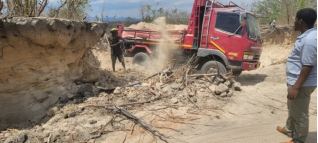
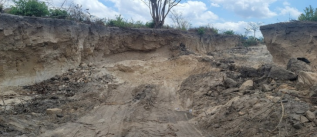
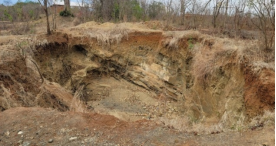
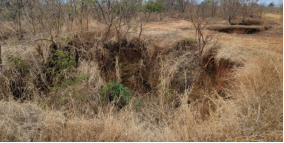
Small-Scale Sand Mining (SSSM) is a common socio-economic activity that employs many members of rural communities in Tanzania. This is largely because it is practiced widely across nearly all districts in the country, where it provides earnings for youth, men and women and supports the construction sector, particularly in fast-growing urban areas. Nonetheless, SSSM appears to be less regulated compared to large-scale mining of precious metals, despite the fact that relevant mining, land and environmental laws formally apply to both scales of mining activities. Such a reality poses a significant threat, which is a pressing global concern, through practices such as clearance of indigenous vegetation, deep excavation, land degradation, and greenhouse gas emissions associated with sand transportation. Notably, this threat is exacerbated by legal, institutional and practical limitations in regulating SSSM. This study focuses on practical limitations, using Mvomero District as a model to exemplify practical limitations that impede mainstreaming of climate change considerations in SSSM activities. This paper adopted a qualitative research methodology. Data was collected through documentary review, interviews, focus group discussions and direct observation to examine how SSSM is practiced on the ground. It found that the manner in which SSSM activities are handled in Mvomero District may exacerbate climate change and its impacts, owing to practices such as unregulated expansion of mining areas beyond legal limits, minimal distance between adjacent SSSM sites, deep excavation that interferes with soil moisture and water tables, inadequate rehabilitation of exhausted sites, weak accountability mechanisms, and increased greenhouse gas emissions from sand transportation. The paper calls for concerted, consistent and inclusive efforts to prevent harmful SSSM practices from further contributing to climate variation in the District.
| Published in | International Journal of Natural Resource Ecology and Management (Volume 11, Issue 1) |
| DOI | 10.11648/j.ijnrem.20261101.12 |
| Page(s) | 13-22 |
| Creative Commons |
This is an Open Access article, distributed under the terms of the Creative Commons Attribution 4.0 International License (http://creativecommons.org/licenses/by/4.0/), which permits unrestricted use, distribution and reproduction in any medium or format, provided the original work is properly cited. |
| Copyright |
Copyright © The Author(s), 2026. Published by Science Publishing Group |
Climate Change, Climate Change Considerations, Small Scale Sand Mining, Tanzania
EIA | Environmental Impact Assessment |
EPP | Environmental Protection Plan |
FGDs | Focus Group Discussions |
GHG | Greenhouse Gas |
PML | Primary Mining License |
SSM | Small Scale Mining |
SSSM | Small Scale Sand Mining |
TSHS | Tanzania Shillings |
| [1] | Nakiya Noorbhai, et al. ‘Continental Mapping of African Sand Mining Highlights Limited Benefits for Local Infrastructure And Socio-Economic Development,’ (2025) 8 One Earth 2. |
| [2] | Aurora Torres, et al. ‘Reducing Sand Mining’s Growing Toll on Marine Biodiversity,’ (2025) 8 One Earth. |
| [3] | Lars Iversen and others, ‘Freshwater Ecosystem Transitions Due to Artisanal Sand Mining in Rwanda, Africa’ (2024) 97 Science of the Total Environment. |
| [4] | Eline Rentier and Erik Cammeraat, ‘The Environmental Impacts of River Sand Mining’ (2022) Science of the Total Environment. |
| [5] | Marius Aparicio, et al. ‘Contribution of Sandy Beaches to the Global Marine Silicon Cycle.’ (2025) 18 Nature Geoscience 154. |
| [6] | Tracey MacKenzie, ‘The Sand Agenda: Transnational Sand Extraction, Social Injustice, and the Urgent Need for Global Governance,’ (2025) 94 Michigan Journal of Political Science 1001 |
| [7] |
Pandey N. S. Kumari and Kumar Gaurav, ‘Sand Mining: A Silent Threat to the River Ecosystem,’ (2024) Springer International Publishing, 109
https://link.springer.com/chapter/10.1007/978-3-031-49163-4_6 |
| [8] | Kai Yuen, et al. ‘Extent of illegal sand mining in the Mekong Delta’ (2024) 5 Communications Earth & Environment 31. |
| [9] | Mette Bendixen and others, ‘Drivers and Effects of Construction-Sand Mining in Sub-Saharan Africa’ (2023) 16 Extractive Industry and Society 10. |
| [10] | Siyabulela Manona, Thembela Kepo and Deon Villiers, ‘Sand Mining Governance in the Post -Apartheid South Africa: Interlegalities of Resources Extraction on the Wild Coast’ (2024) 20 The Extractive Industries and Society 101542. Doi: |
| [11] | Dhana R. Raju, ‘Critical Minerals-U-Th, Recoverable from the Placer Valuable Heavy Minerals in Mineral Sand Deposits,’ (2025) 10 International Journal of Research and Innovation in Applied Science 807. |
| [12] | National Audit Office, ‘Performance Audit Report on the Provision of Support to Small-Scale Miners’ (National Audit Office 2024). para 3.2.1. |
| [13] | National Audit Office, ‘Study on the Status of Environment with a Focus on Land Degradation, Forest Degradation and Deforestation’ (Controller and Auditor General of Tanzania 2018). pp 37-38. |
| [14] | Christina Shitima and Bert Suyken, ‘Formalization of Sand Mining in Dar Es Salaam, Tanzania’ (2023) 82 Resource Policy. |
| [15] |
Francis Kajubi, ‘Special Report: Sand Mining: A Dilemma of Job Creation and Worsening Climate Change Risks -3’ The Guardian (Dar es Salaam, 4 September 2024)
https://www.ippmedia.com/the-guardian/business/read/special-report-sand-mining-a-dilemma-of-job-creation-and-worsening-climate-change-risks-3-2024-09-03-153900 (accessed 12 March 2025). |
| [16] |
Tran T. Kim, et al. ‘The Impact of Sand Mining on the Bed Morphology of the Tien River, Mekong Delta, Vietnam’ (2025) 84 Environmental Earth Sciences 1.
https://link.springer.com/article/10.1007/s12665-024-12079-y |
| [17] | Edward Park, ‘Sand Mining in the Mekong Delta: Extent and Compounded Impacts’ (2024) 924 Science of the Total Environment 171620. Doi: |
| [18] | Alan Bryman, Social Research Methods (4th edn, Oxford University Press 2012). p 425. |
| [19] | Williams Granville, Learning the Law (15th edn, Sweet & Maxwell 2013). |
| [20] | Saidi Kambi, et al. ‘Assessment of Precipitation and Temperature Trends in Kilosa District, Morogoro, Tanzania’ (2025) 24 Asian Journal of Environment & Ecology 1. Doi: |
| [21] |
VPO, ‘National Environmental Master Plan for Strategic Interventions 2022-2032’ para 2.1 and 3.1.
https://www.vpo.go.tz/uploads/files/MASTER%20PLAN-English_eBOOK_FINAL.pdf |
| [22] | United Republic of Tanzania (PMORALG), ‘Mvomero District Investment Profile.’ |
| [23] | Venance Shilingi and Eliza Mwakasangula, ‘Navigating Conflict: A Cross-Sectional Study of Farmers and Pastoralists Conflicts in Kilosa, Tanzania’ (2024) 35 Global Change, Peace & Security. |
| [24] | Mahato Anupama, ‘Climate Change and its Impact on Agriculture’ (2014) 4 International Journal of Scientific and Research Publications 1; Piers M. Forster, et al. ‘Indicators of Global Climate Change 2023: Annual update of key indicators of the state of the climate system and human influence,’ (2024) Earth System Science Data 2625. |
| [25] | The Paris Agreement 2015, article 4(1) (b). |
| [26] |
United Republic of Tanzania-Vice President’s Office, ‘Third State of the Environmental Report’ (2019)
https://www.vpo.go.tz/uploads/publications/en-1592550740-State%20of%20Environment-pdf (accessed 12 April 2025). |
| [27] | Maria G. Njau, ‘Climate Coloniality and The Burden of Tree Planting among Youth in Tanzania,’ (2025) Intercultural Education 1. |
| [28] | Anne Hinzmann, et al. ‘Tropical Glacier Loss in East Africa: Recent Areal Extents on Kilimanjaro, Mount Kenya, and in the Rwenzori Range from High-resolution Remote Sensing Data,’ (2024) 3 Environmental Research: Climate 011003. |
| [29] |
VPO, ‘National Climate Change Response Strategy 2021-2026’ p 53.
https://www.taees.org/wp-content/uploads/2021/09/NCCRS-2021-2026_-Final_PK.pdf |
| [30] | Kristina Douglass and Jago Cooper, ‘Archaeology, Environmental Justice, and Climate Change on Islands of the Caribbean and Southwestern Indian Ocean’ (2020) 117 Proceedings of the National Academy of Sciences 8254. |
| [31] |
The Citizen Reporter, ‘Confusion Reigns in Small-Scale Mining’ The Citizen (2021)
https://www.thecitizen.co.tz/tanzania/business/confusion-reigns-in-small-scale-mining-2580720 |
| [32] | Esther Somi, ‘Institutional Gaps in Tanzania’s Environmental Regulations,’ (2022) 83 South African Journal of Social & Economic Policy 51. |
| [33] | Mike Mentis, ‘Environmental rehabilitation of damaged land’ (2020) 7(1) Forest Ecosystems 1. |
APA Style
Bakta, S., Ombella, J., Kilonzo, C. (2026). Mainstreaming Climate Change Considerations in Small-scale Sand Mining: Practical Challenges in Selected Villages in Mvomero District, Tanzania. International Journal of Natural Resource Ecology and Management, 11(1), 13-22. https://doi.org/10.11648/j.ijnrem.20261101.12
ACS Style
Bakta, S.; Ombella, J.; Kilonzo, C. Mainstreaming Climate Change Considerations in Small-scale Sand Mining: Practical Challenges in Selected Villages in Mvomero District, Tanzania. Int. J. Nat. Resour. Ecol. Manag. 2026, 11(1), 13-22. doi: 10.11648/j.ijnrem.20261101.12
@article{10.11648/j.ijnrem.20261101.12,
  author = {Seraphina Bakta and John Ombella and Claudi Kilonzo},
  title = {Mainstreaming Climate Change Considerations in Small-scale Sand Mining: Practical Challenges in Selected Villages in Mvomero District, Tanzania},
  journal = {International Journal of Natural Resource Ecology and Management},
  volume = {11},
  number = {1},
  pages = {13-22},
  doi = {10.11648/j.ijnrem.20261101.12},
  url = {https://doi.org/10.11648/j.ijnrem.20261101.12},
  eprint = {https://article.sciencepublishinggroup.com/pdf/10.11648.j.ijnrem.20261101.12},
  abstract = {Small-Scale Sand Mining (SSSM) is a common socio-economic activity that employs many members of rural communities in Tanzania. This is largely because it is practiced widely across nearly all districts in the country, where it provides earnings for youth, men and women and supports the construction sector, particularly in fast-growing urban areas. Nonetheless, SSSM appears to be less regulated compared to large-scale mining of precious metals, despite the fact that relevant mining, land and environmental laws formally apply to both scales of mining activities. Such a reality poses a significant threat, which is a pressing global concern, through practices such as clearance of indigenous vegetation, deep excavation, land degradation, and greenhouse gas emissions associated with sand transportation. Notably, this threat is exacerbated by legal, institutional and practical limitations in regulating SSSM. This study focuses on practical limitations, using Mvomero District as a model to exemplify practical limitations that impede mainstreaming of climate change considerations in SSSM activities. This paper adopted a qualitative research methodology. Data was collected through documentary review, interviews, focus group discussions and direct observation to examine how SSSM is practiced on the ground. It found that the manner in which SSSM activities are handled in Mvomero District may exacerbate climate change and its impacts, owing to practices such as unregulated expansion of mining areas beyond legal limits, minimal distance between adjacent SSSM sites, deep excavation that interferes with soil moisture and water tables, inadequate rehabilitation of exhausted sites, weak accountability mechanisms, and increased greenhouse gas emissions from sand transportation. The paper calls for concerted, consistent and inclusive efforts to prevent harmful SSSM practices from further contributing to climate variation in the District.},
 year = {2026}
}
TY  - JOUR
T1  - Mainstreaming Climate Change Considerations in Small-scale Sand Mining: Practical Challenges in Selected Villages in Mvomero District, Tanzania
AU  - Seraphina Bakta
AU  - John Ombella
AU  - Claudi Kilonzo
Y1  - 2026/01/26
PY  - 2026
N1  - https://doi.org/10.11648/j.ijnrem.20261101.12
DO  - 10.11648/j.ijnrem.20261101.12
T2  - International Journal of Natural Resource Ecology and Management
JF  - International Journal of Natural Resource Ecology and Management
JO  - International Journal of Natural Resource Ecology and Management
SP  - 13
EP  - 22
PB  - Science Publishing Group
SN  - 2575-3061
UR  - https://doi.org/10.11648/j.ijnrem.20261101.12
AB  - Small-Scale Sand Mining (SSSM) is a common socio-economic activity that employs many members of rural communities in Tanzania. This is largely because it is practiced widely across nearly all districts in the country, where it provides earnings for youth, men and women and supports the construction sector, particularly in fast-growing urban areas. Nonetheless, SSSM appears to be less regulated compared to large-scale mining of precious metals, despite the fact that relevant mining, land and environmental laws formally apply to both scales of mining activities. Such a reality poses a significant threat, which is a pressing global concern, through practices such as clearance of indigenous vegetation, deep excavation, land degradation, and greenhouse gas emissions associated with sand transportation. Notably, this threat is exacerbated by legal, institutional and practical limitations in regulating SSSM. This study focuses on practical limitations, using Mvomero District as a model to exemplify practical limitations that impede mainstreaming of climate change considerations in SSSM activities. This paper adopted a qualitative research methodology. Data was collected through documentary review, interviews, focus group discussions and direct observation to examine how SSSM is practiced on the ground. It found that the manner in which SSSM activities are handled in Mvomero District may exacerbate climate change and its impacts, owing to practices such as unregulated expansion of mining areas beyond legal limits, minimal distance between adjacent SSSM sites, deep excavation that interferes with soil moisture and water tables, inadequate rehabilitation of exhausted sites, weak accountability mechanisms, and increased greenhouse gas emissions from sand transportation. The paper calls for concerted, consistent and inclusive efforts to prevent harmful SSSM practices from further contributing to climate variation in the District.
VL  - 11
IS  - 1
ER  -
Public Law Department, Mzumbe University, Morogoro, United Republic of Tanzania
Biography: Seraphina Bakta (Ph.D) is a Senior Lecturer at the Faculty of Law, Mzumbe University in Tanzania. She holds a Ph.D (University of Cape Town); LLM (University of Cape Town) and an LLB (Mzumbe University). Her current research interest include human rights; children’s rights; women rights; restorative justice; environmental and climate change law.
Private Law Department, Mzumbe University, Morogoro, United Republic of Tanzania
Biography: John Ombella is a Lecturer at the Faculty of Law, Mzumbe University. He holds LL.B (Mzumbe University); LL.M (University of Western Cape); and LL.D (OUT); Certificate on Sustainable Development and Human Rights Law (Antwerp University-Belgium 2017), Certificate on Climate Change International Legal Regime (UNITAR/UNEP 2024), Founder and Director of Mine-host Communities Initiative (MHCI 2022). He is an Advocate of the High Court and Subordinate Courts – Tanzania.
Public Law Department, Mzumbe University, Morogoro, United Republic of Tanzania
Biography: Claudi Kilonzo is an Assistant Lecturer at the Faculty of Law, Mzumbe University. He holds LL.B (Mzumbe University) and LL.M (Mzumbe University). His research interest is on environmental and climate change law.




 Share This Article
 Twitter
 Linked In
 Facebook
 Copy
Copy Download