Research Article | | Peer-Reviewed

Characterization, Classification and Mapping of Soil Salinity Status at Small Scale Irrigation Farm of Kedale, Yabello District, Borana Zone, Southern Ethiopia

Received: 17 March 2025     Accepted: 7 April 2025     Published: 28 April 2025
Views:       Downloads:
Abstract

Soil salinity is a significant challenge to crop productivity, particularly in arid and semi-arid regions. Effective mitigation requires a thorough understanding of soil chemical composition and water quality before implementing sustainable irrigation projects. This study aimed to characterize, classify, and map soil salinity and sodicity in the small-scale Kedale irrigation area of Yabello district. A total of 42 composite soil samples were collected from irrigated farm plots at four depths (0-30 cm, 30-60 cm, 60-90 cm, and 90-120 cm) and analyzed for soil texture, pH, electrical conductivity (EC), cation exchange capacity (CEC), exchangeable bases (Ca, Mg, Na, K), exchangeable sodium percentage (ESP), and sodium adsorption ratio (SAR). Soil salinity and sodicity were mapped using ArcGIS 10.8 with Kriging interpolation. Additionally, irrigation water samples were analyzed for ECe, pH, ESP, and SAR to assess water quality. The results showed that soil texture varied from sandy loam at shallow depths to sandy clay at deeper layers. The soil's average ESP, EC, and pH were 16.41%, 3.99 mmhos/cm, and 8.62, respectively, indicating that it is sodic according to FAO classification. Irrigation water analysis further revealed a slightly sodic nature. To ensure sustainable agricultural productivity in the Kedale irrigation scheme, immediate soil salinity management is recommended. Key interventions include gypsum application, organic amendments such as compost, the cultivation of salt-tolerant crops, the adoption of environmentally friendly irrigation practices, and farmer education on effective land and water management strategies.

Published in International Journal of Natural Resource Ecology and Management (Volume 10, Issue 2)
DOI 10.11648/j.ijnrem.20251002.12
Page(s) 68-79
Creative Commons

This is an Open Access article, distributed under the terms of the Creative Commons Attribution 4.0 International License (http://creativecommons.org/licenses/by/4.0/), which permits unrestricted use, distribution and reproduction in any medium or format, provided the original work is properly cited.

Copyright

Copyright © The Author(s), 2025. Published by Science Publishing Group

Keywords

Composite, Saline Soil, Sodic Soil, Productivity, Soil Profile

1. Introduction
Soil degradation presents a major challenge globally, especially in numerous developing nations where a large segment of the population relies on soil for their livelihoods . Soil salinity is the second biggest contributor to land degradation, after soil erosion, and it has been connected for 10,000 years to the downfall of agricultural communities . It may arise from the weathering of rocks and minerals or the accumulation of salts driven by irrigation in areas with inadequate drainage . Globally, salt-affected soils are a problem that affects every continent in nearly all climates . However, their distribution is generally more widespread in arid and semi-arid regions compared to humid areas. In various parts of the world, the development of sodic soils and soil salinity, which contribute to land degradation, result from inadequate irrigated agriculture in arid and semi-arid regions. Degradation of a land attributed to soil salinity problem became major threats to small-scale agriculture in Africa. According to findings by Paul & Lade , salinity affects 1,899 million hectares of land in Africa.
Therefore, researching arid lands and salt-affected soils has become a crucial subject for contemporary agricultural management, especially in impoverished countries like Ethiopia, where agriculture is fundamental to the economy and over 60% of the land is classified as arid or semi-arid . Nine percent (9%) of the Ethiopian population lives in areas affected by salinity. The semi-arid and arid lowlands and valleys in Ethiopia face significant issues with salinity and alkalinity. Approximately 44 million hectares, or 36% of the country's total land, are potentially vulnerable to salinity issues. Of this 44 million hectares, 33 million hectares predominantly experience salinity problems, 8 million hectares have a combination of salinity and alkalinity issues, and 3 million hectares are primarily affected by alkalinity .
Salt-affected soils are typically found in irrigated areas, particularly in arid and semi-arid areas when annual rainfall is insufficient to fulfill plant evaporation requirements and salt leaching . Additionally, it influences plant growth through the development of an osmotic pressure inside the plants, which causes the roots to take harder to absorb water . This is attributed to the constantly changing climatic conditions, high rates of evapotranspiration, insufficient water for leaching, and poor quality of irrigation water . According to many reports, the majority of Ethiopia's land affected by salinity and/or sodicity is located in the Rift Valley area . Hence, it is anticipated that the adoption of intensive irrigation practices in this irrigation scheme may lead to a gradual buildup of salts and a decline in agricultural production. Research has shown that ongoing irrigation practices can impact the potential for agricultural production due to salt accumulation in irrigated fields .
Research on salt-affected agricultural soils in the Southern Ethiopia Rift Valley remains sparse, indicating a significant knowledge gap. The lack of comprehensive assessments of irrigation water quality and soil salinity makes difficult to develop intervention scenarios and successful restoration plans. This lack of information has left communities without adequate understanding of soil salinity/sodicity status, the causes of waterlogging, and optimal management practices for irrigated farmland. Addressing these gaps is essential, as successful reclamation efforts can enhance agricultural productivity, improve food security, reduce water consumption, and promote soil health, potentially leading to a 50% increase in crop yields and a reduction in pest and disease prevalence. Therefore, the present investigation will be planned to study the extent of salinity status of Kedale irrigation farm and to map its spatial distribution through a geo-statistical and geo-spatial approach.
Objectives:
To characterize, classify and map small scale kedale irrigation area of Yabello district.
2. Materials and Methods
2.1. Description of the Study Area
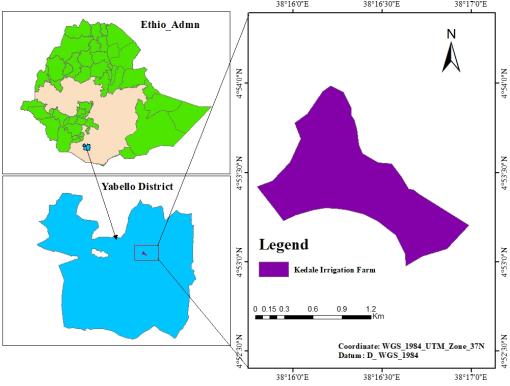
The study was conducted in the Kedale Irrigation Scheme of Yabello District, Borana Zone of Oromia Regional State, and Southern Ethiopia. It is located at 570 km south of Addis Ababa, and both the Ganale-Dawa and Rift-Valley River basins cross through it. Its altitude varies from 1000 to 1800 meters above sea level (masl) at the latitude and longitudes of 4°52'48.19''-4°53´59.9´´ N and 38°15'45.1''-38°17´20.8´´ E, respectively . Yabello District has bimodal rainfall, with the main rainy season locally known as Ganna (60%) is occurring during March to May and the short rainy season locally called Hagaya (30%) occurring from October to November. The mean annual rainfall in the Yabello district ranges from 400 mm to 900 mm with high altitudinal variability. The climatic data of Yabello metrological station indicated that the mean annual maximum and minimum temperature are 28.5oC and 12.3oC, respectively .
2.2. Soil and Farming Practices
The soil types in the study area include Chromic Cambisol, Eutric Cambisol, Chromic Luvisols, Epileptic Leptosol, and Pellic Vertisol, which are classified into five main textural classes: clayloam, sandyclayloam, loamysand, clay, and loam . Chromic Luvisols were found to be the dominant soil type, which accounts for 79.4% of the total study area . The major crops grown in the study area are maize (Zea mays), tef (Eragrostis tef), and haricot bean (Phaseolus vulgaris) . Farmers generally cultivate crops using rainfed agriculture as a crop-livestock mixed farming system, and irrigation has also become a vital component of agricultural production activities.
2.3. Soil Sampling
Based on the topographic and soil variability of the schemes, the study area was classified into different mapping units. In this study, the mapping unit opened was five (four pits were from irrigated farms and one was from rain fed) based on the criteria set for agricultural salt-affected soil studies by Wogi et al . As a control, soil samples from rain-fed farmland were also gathered using a similar methodology. Every sampling point was georeferenced. Soil samples were taken for this study. down to a depth of 120 cm, which was divided into four sampling depths: 0-30 cm, 31-60 cm, 61-90 cm, and 91-120 cm. This depth is the most commonly used for soil salinity assessment . Accordingly, 42 soil samples in all were collected and submitted to the soil analytical lab of the Yabello Pastoral and Dryland Agriculture Research Center.
Figure 1. Map of the Study Area.
2.4. Soil Analysis
The soil samples collected were air-dried, ground to pass through a 2 mm sieve, and stored in clean sample bags for analysis . Following standard testing procedures, the samples were analyzed for various chemical properties, including the electrical conductivity (EC) of the soil solution (using a 1:2.5 soil-to-water ratio), soil pH, cation exchange capacity (CEC), and exchangeable bases (Calcium, Magnesium, Sodium, and Potassium). The soil pH was measured with a pH meter using a 1:2.5 ratio of distilled water to soil solution, while the EC was determined using saturated paste extracts. The cation exchange capacity (CEC) of the soils was determined using an extracted excess ammonium acetate solution. Sodium (Na) and potassium (K) levels were quantified through flame photometry. Soluble calcium and magnesium were measured via titration with ethylenediaminetetraacetate (versenate), as outlined by Zhang et al . Finally, the exchangeable sodium percentage (ESP) was calculated as the ratio of exchangeable sodium to the cation exchange capacity (CEC) of the soil, expressed as a percentage, using the following formula:
ESP %=Exchangeable sodium (Na+)CEC*100
2.5. Characterization of Salt Affected Soils
The following criteria, set by the US Department of Agriculture , were used to classify the soils into the various salt-affected soil classes:
Table 1. Guideline for classification of salt-affected soils.

Classification

EC of saturation extracts (ECe) at 25°C (mmhos/cm)

Exchangeable Na percentage (ESP)

pH (H2O)

Soil physical condition

Saline

>4

<15

<8.5

Normal

Sodic (alkali)

<4

>15

>8.5

Very poor

Saline sodic

>4

>15

>8.5

Normal

Non-saline non-sodic

<4

<15

≈7.0

Normal

Source: FAO, 2020.
Table 2. Criteria for determining the level of salinity and sodicity in soil.

Salinity (ECe in dS/m)

Sodicity (ESP in%)

Intensity

FAO (2008)

Intensity

FAO (2008)

Non saline

0.75

Non-sodic

6

Slightly saline

0.75-2

Slightly sodic

6-10

Moderately saline

2-4

Moderately sodic

10-15

Strongly saline

4-8

Strongly sodic

15-25

Very Strongly saline

8-15

Extremely sodic

>25

Source: FAO, 2020.
2.6. Soil Salinity Mapping
ArcGIS 10.8 was used to map the salinity/sodicity of the soil using electrical conductivity and the proportion of exchangeable sodium. The electrical conductivity and exchangeable sodium percentage values at unsampled locations were estimated using the Kriging model , while the other soil quality metrics were spatially mapped using Inverse Distance Weight (IDW) .
2.7. Water Sampling and Analysis
Water samples were collected from various points along the schemes' high, middle, and lower irrigation canals. Polyethylene (plastic) bottles were used to collect the water sample. The samples were transported to the laboratory and analyzed for their chemical composition. In general, irrigation water sample collection and processing followed the guidelines provided by the US Department of Agriculture . The pH, EC, and dissolved cations (Ca, Mg, Na, and K) of the water samples that were collected were analyzed. Using a conductivity meter and a digital pH meter, the water samples' EC and pH were measured in a lab within a day. Exchangeable Na and K were examined using a flame photometer, whereas soluble Ca and Mg were determined using EDTA titration. The General guidelines used for classification of salinity/sodicity hazard of irrigation water was based upon EC and Sodium Adsorption Ratio (SAR) in me/100g soil.
SAR=Na+(Ca2++Mg2+)2
Table 3. General guidelines for salinity class of irrigation water USSL staff (1994).

No.

Salinity class

EC (mmhos/cm)

Sodicity class

SAR value

1

Low saline

0.1- 0.25

Low Sodicity

<10

2

Medium saline

0.25-0.75

Medium Sodicity

10 to 18

3

High saline

0.75 - 2.25

High Sodicity

18 to 26

4

Very high saline

>2.25

Very high Sodicity

>26

Source: FAO, 2020.
3. Results and Discussions
3.1. Soil Physical Characteristic: Textural Classes
This result showed that for 0-30cm, Kedale Irrigation Site’s Soil texture was Sandy Loam and sandy clay loam for 30-60cm it was sandy clay, for 60-90cm it was sandy clay loam for 90-120cm it was sandy clay (Table 4). The soil texture shows a general trend from sandy loam at shallower depths to sandy clay at greater depths, suggesting a need for balanced irrigation and nutrient management practices to optimize crop growth. The study also showed that there is some difference in the texture of the studied pits. Soil textural differences could be used to study soil formation processes because they can reveal information about the parent material as well as the rate of soil formation and nutrient supply. The textures of clayey and sandy soils differ; sand formed more slowly because of its smaller surface area and weathering process. Because of their greater surface area and ability to connect with minerals that are more readily absorbed by plants, clayey soils are able to contain more nutrients than other types of soil. The study of soil texture on these irrigational farms indicates a variation in clay and silt percentages with depth, which may affect crop management strategies. The variation in silt percentage is significantly higher, indicating more variability in silt across different depths than sand or clay. The significant variation in clay and silt across the different depths points to unique conditions that may be leveraged or need to be managed differently based on specific farming practices.
Table 4. Soil textural analysis at different depth of Kedale irrigation land.

No

Depth

%sand

%clay

%silt

Soil Textural class

1

0-30

61.45

18.77b

19.78a

Sandy Loam

2

30-60

57.92

32.65a

9.43b

Sandy clay Loam

3

60-90

52.26

39.34a

8.39b

Sandy clay

4

90-120

56.65

31.63a

11.72b

Sandy clay loam

CV

11.73

21.17

43.25

LSD

ns

8.93

7.35

P- Value

0.24

0.0022

0.02

3.2. Soil Chemical Characteristics
3.2.1. Soil Reaction (pH)
Soil pH is therefore an ideal means of determining the level of acidity or alkalinity that is present in the soil as well as the chemical impact that might be occurring on the chemical constitution of the earth, its influence on plant growth and health. The study area's soil pH values varied from 7.97 to 9.75, with a mean of 8.62 and a CV of 4.28. The low CV of 4.28% (Table 5) confirmed that the pH values of the soil were consistent across the entire study area. The soils in the irrigation scheme fall into the neutral to a moderately alkaline category according to Jones et al classification of soil alkalinity, which emphasizes the importance of soil pH in relation to appropriate crop watering techniques and the maximum realization of yields per unit area because different crops have varying tolerance levels to various soil types, whether they are acidic or alkaline.
Sodic soils have a high pH (usually between 8.0 and 10) and a high exchangeable sodium percentage (>15%), according to a FAO study on soil salinity guidelines. These soils have several negative consequences on plant development. Sodium ions are known to be toxic to plants and they affect the nutrition and metabolism of the plants. Sodic soils have a high pH which is normally detrimental to most plant species. High pH limits macronutrient nutrient access such as calcium, magnesium and phosphorus as well as micronutrient inadequate availability . These accumulated in plants as sodium, molybdenum, and boron can lead to direct poisonousness, detrimental physical modification of the plant architecture, and stunted growth and kill even more delicate plants.
3.2.2. Soil Electrical Conductivity (EC)
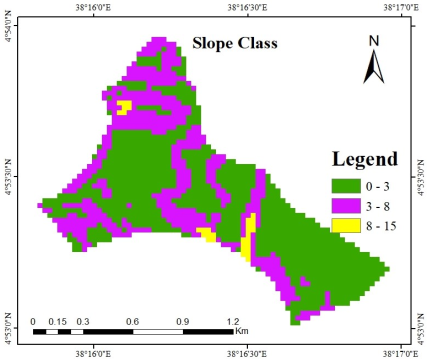
Figure 2. Slope Class of Kedale Irrigation Farm.
A saturated extract from soil paste (ECe) is used in the measurements to determine the total amount of soluble salts. The saturated extract technique is the recommended approach since it considers the texture of the soil. The electrical conductivity (EC) is generally moderately saline, which ranges between 3.25 μS/m in the sub soil (90-120 cm) and 5.11 μS/m in the first soil depth (0-30 cm) with a mean of 3.99 μS/m. Furthermore, a declining trend in the EC value was observed at the soil depth sampling locations (Figure 2). The research report by W. Al-Jassem et al , which clearly stated that soil electrical conductivity decreases with soil depth, significantly agrees with this finding. This is mostly because of the sodic soil properties that can lower soil water infiltration and the poor leaching of saline soil to the subsurface, which resulted in salinity building up on the plough layer. But this scenario is impractical, particularly when the problem of soil salinity is caused by concentrated or saline groundwater recharge. In this case, as the depth of the soil increases, soil salinity in general and EC values in particular increase. In consistent with this finding Kasahun et al noted that inadequate water infiltration can result in waterlogging, poor drainage, and increased EC on the surface and subsurface soil. Therefore, EC values at the Kedale irrigation water are in the range of moderately saline to strongly saline and have the potential to restrict plant growth and crop yield.
3.2.3. Cation Exchange Capacity (CEC)
Table 4 shows that the CEC of the soils varied from 15.88 to 33.62 cmolc·kg−1. The CEC of the soils in the irrigation scheme fall into the medium to high category based on rating of Hazelton, and Murphy . This classification indicates that the soil has a moderate capacity to hold cations, which can affect nutrient availability for plants. The soils with a high CEC are more fertile and have the capacity to store more cations. In line with this findings Bonanomi stated that, the soils in the study area have a moderately high CEC, indicating that they are fertile and able to sustain a wide range of plant development. The CEC of the soil is influenced by the type of soil, the amount of clay and organic matter in the soil, and the pH of the soil . Clay particles have a greater CEC than sand-based soils because they can bind more cations and have a greater surface area. In agreement with these results, Wogi et al state that CEC is increased above the high value (25-35 cmolc kg−1) for both surface depth (0-30 cm) and subsurface depth (30-60 cm) of saline soils, suggesting that restoration might make the soils productive. Hence, more weatherable primary minerals may be present in the soils of the Kedale Irrigation area, acting as a reservoir of plant nutrients, which explains the unusually high CEC rating. Therefore, if other conditions are appropriate, these soils are considered productive .
Table 5. Soil salinity status at Kedale irrigation schemes.

Depth

pH

EC (dS/m)

CEC (cmol (+)/kg)

Exch. Na

Exch. Ca

Exch. Mg

Exch. K

ESP

class

Surface

7.88c

4.56a

28.89ab

4.23ab

2.86ab

3.78

1.56ab

14.64

saline

0-30

7.97c

5.11a

28.86ab

4.04ab

3.92a

6.84

1.87a

13.99

saline

30-60

8.63bc

3.62a

33.62a

6.35a

3.58a

6.79

1.50ab

19.00

sodic

60-90

8.87ab

3.42b

22.19bc

4.75ab

2.42b

7.73

1.34b

18.63

sodic

90-120

9.75a

3.25b

15.88c

3.25b

2.34b

7.94

1.22b

15.77

sodic

Mean

8.62

3.99

25.89

4.52

3.02

6.62

1.50

16.41

sodic

CV

4.28

20.81

23.95

28.85

19.23

15.54

22.03

30.76

LSD

0.48

1.19

8.76

1.93

0.81

ns

0.45

ns

P- Value

0.01

0.01

0.07

0.03

0.002

0.30

0.04

0.78

3.3. Characterization of Soil Salinity Status at Kedale Irrigation Scheme
Table 5 demonstrates that the levels of cation exchange capacity (CEC) and exchangeable sodium percentage (ESP) varied significantly at (p < 0.05) across the different sampling depths. At a depth of 30 to 60 cm, the highest ESP of 19% and at the depth 0-30cm the lowest ESP of 13.99% were measured. These analyses indicated that the soil within the Kedale irrigation scheme was classified as strongly sodic at depths ranging from 30 to 120 cm, while it was categorized as moderately sodic at depths from 0 to 30 cm. The site's average soil pH, ESP, and EC were 8.62, 3.99 ds/m, and 16.41%, respectively, suggesting that the soil was classified as sodic. The FAO's system of sodic soil classification guidelines state that a soil is considered sodic if its pH is more than 8.5, its Exchangeable Sodium Percentage (ESP) is greater than 15, and its EC is less than 4 ds/m. Presence of high level of Na+ system in sodic soils; reduces levels of Ca2+ and Mg2+ and remain adsorbed onto clay particles hence leading to severe structural degradation . Similar studies have also shown that low yearly rainfall combined with high daily temperatures increases water evaporation, which in turn increases the buildup of soluble salts in the lowlands .
Table 6. Relative risk of soil salinity and it’s area coverage.

No

EC (ds/m)

Area (%)

Risk Level

0

0-2

27.6

Low

1

2-4

51.0

Medium

2

>4

21.4

High

Total

100

3.4. Distribution of EC at Kedale Irrigation Scheme
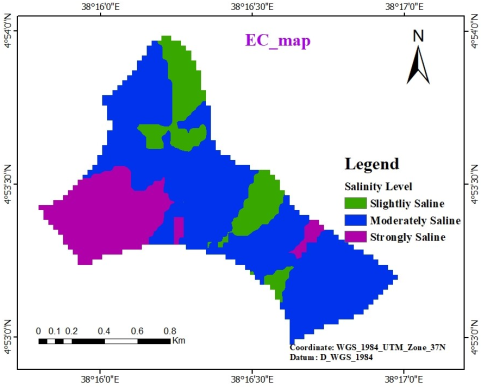
The geospatial analysis results (Figure 4) indicate that a significant portion of the total irrigated land is characterized by moderately and strongly alkaline conditions. Specifically, 27.6% of the soil samples were classified as slightly alkaline, while 51% and 21.4% were categorized as moderately alkaline and strongly alkaline, respectively. This suggests that the majority of the area (78.6%) is at a medium or low risk level; however, 21.4% of the area is classified as facing high salinity risk, which poses potential challenges for agricultural activities (Table 6). Consequently, it is essential to implement effective management strategies in regions with elevated salinity levels to promote sustainable land use.
The electrical conductivity (ECe) of the Timuga irrigation system in Southern Tigray ranged from 0.125 to 12.89 mScm−1, with an average value of 0.76 mScm−1, according to Aredehey et al. . Of the overall area, 24.7% is rated as having medium salinity risks, while the great majority of the scheme (75.3%) is classified as having low salinity risk hazards. This conclusion is also consistent with the findings of Zewdu et al. , who found that the distribution was associated with shallow groundwater and that salinity had an impact on the irrigated crops in the study areas. The reason for this is the long-term irrigation technique that uses shallow groundwater, which causes salts to build up on the middle catchment's surface and disperse throughout the root zone.
Figure 3. Map showing the Kedale Irrigation Scheme's EC level.
3.5. Distribution of ESP at Kedale Irrigation Scheme
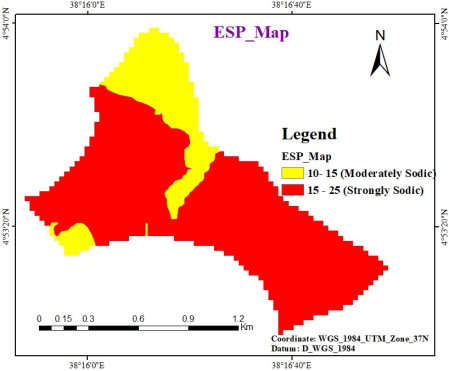
Table 6 presents the exchangeable sodium percentage (ESP) levels in soil, detailing the corresponding area percentages and associated risk levels for each ESP range. Notably, 20.79% and 66.71% of the area are classified as high and very high risk, respectively, due to elevated sodium levels, which can significantly affect soil structure and agricultural productivity, including reduced crop yields and soil degradation, necessitating careful management. Besides, the data reveals that a substantial majority (87.5%) of the area is at medium to very high risk due to sodium levels, with over two-thirds classified as very high risk. Therefore, the soils of the Kedale irrigation scheme were classified as severely sodic (Figure 5) according to the FAO system of soil salinity classification. In order to ensure sustainable agricultural practices and preserve soil health, it is imperative that appropriate management measures be used to minimise excessive ESP levels. This finding is similar to that of Chekol and Mnalku's study , which discovered that the middle awash irrigated farm fields had sodic soils because of the high salt content in other parts of the region. In contrast to the other areas of the watershed, the center of the catchment has likely seen sodicity due irrigated for many years and inherent water logging issues.
Table 7. Relative risk of soil sodicity and its area coverage.

No

ESP (%)

Area (%)

Risk Level

0

10-15

12.50

Medium

1

15-25

20.79

High

2

>25

66.71

Very High

Total

100.00

Figure 4. Map indicating the level of ESP at Kedale Irrigation scheme.
3.6. Status of Irrigation Water Quality at Kedale Irrigation Schemes
3.6.1. Sodium Absorption Ratio (SAR)
Based on established irrigation water quality standards and salinity control techniques, the sodium hazard associated with the Kedale River pond serving as the primary irrigation water source for the district was classified as low. The results of the irrigation water analysis indicate that the water utilized in the Kedale irrigation schemes is slightly sodic, suggesting that while it may not pose immediate risks, careful monitoring is essential. It is important to note that a SAR value exceeding nine (>9) is considered severely restrictive for irrigation due to the associated risks of sodium hazard. According to the guidelines established by researchers such as Biswas FAO and Wescott and Ayers this threshold serves as an early warning indicator for potential sodic soil formation in the region.
Table 8. The EC and SAR of water for irrigation.

Description

pH

EC (ds/m)

Salinity class

SAR

Sodicity Hazards (FAO, 2008)

Upper

7.82

0.11

Low saline

5.0

Low sodicity

Middle

7.74

0.21

>>

6.5

>>

Lower

7.63

0.15

>>

4.8

>>

Mean

7.73

0.16

5.43

3.6.2. pH and EC of the Water
The acidity or alkalinity of the soil is measured by its pH, which is an essential characteristic since it affects how nutrients (cations and anions) are supplied to plants, how toxic substances behave chemically, and how microbes behave. The analysis of the Kedale River pond reveals a pH of 7.73, categorizing it as slightly saline and approaching neutrality. This finding is crucial for understanding the pond's ecological dynamics and its suitability for various biological activities. The pH level suggests that the pond may have a balanced environment conducive to the growth of diverse aquatic plants and microorganisms, which are vital for maintaining the health of the ecosystem (see Table 8 for reference). Electrical conductivity (EC) is another important parameter that reflects the concentration of dissolved salts in water, which can affect both plant growth and water quality. It is necessary to use a temperature adjustment of 2.3% to adjust the EC results from the analysis at room temperature to 25°C. Consequently, the lab result demonstrated that the water's EC is categorised as low (0.16 EC (dS/m) according to several researchers' classifications , providing a framework for understanding the salt levels and their consequences for the ecological health of the pond and the sustainability of agriculture.
3.7. Source of Soil Salinity Problem at Irrigation Schemes
Natural processes include chemical or physical weathering, transfer from source material, geological deposits, increasing salt-affected groundwater, and weathering of soil minerals chemically are the main causes of primary salinization . On the other hand, secondary salinization at the Kedale irrigation scheme is primarily driven by low and erratic rainfall, high temperatures, and low humidity, which significantly affect soil salinity. Insufficient rainfall limits natural leaching, leading to salt accumulation in the root zone, disrupting osmotic balance and nutrient uptake, causing crop stress, and reducing agricultural productivity. Additionally, high temperatures and low humidity elevate evaporation rates, concentrating salts in the soil and exacerbating salinity .
Furthermore, many soils in the region are alkaline, characterized by a pH greater than 7, which can worsen salinity issues, especially when irrigation practices fail to manage salt levels effectively. High pH can lead to the precipitation of certain nutrients, reducing their availability to plants while promoting the accumulation of sodium and other salts. Moreover, traditional irrigation techniques on Kedale irrigation farms often fail to manage water application effectively, leading to waterlogging and salt accumulation. Inefficient methods result in uneven water distribution, promoting localized salinity issues as waterlogged areas cause capillary rise, bringing salts to the surface . Similarly, extended usage of Awash River irrigation water in June causes problems for crops that are vulnerable to salt . Limited access to resources, technology, and knowledge for effective irrigation and land management practices can hinder farmers' ability to address salinity problems.
4. Conclusions
Soil salinity poses a significant environmental threat that hinders crop productivity, especially in arid and semi-arid regions. To address this issue effectively, it is crucial to understand the soil's chemical composition and the overall condition of water before implementing any sustainable irrigation projects. The findings regarding soil texture indicate a general trend from sandy loam at shallower depths to sandy clay at greater depths. This variation underscores the necessity for balanced irrigation and nutrient management practices to optimize crop growth. The average ESP, EC and soil pH of the site were 16.41%, 3.99 mmhoms/cm and 8.62, respectively. The result showed soil pH>8.5, EC<4, and ESP>15 were observed on the land irrigated using diversion water in the schemes indicating that the soil was classified as sodic soil. Sodium concentration (Na+) and EC level was found to be declining with the sampling depth from 0-120cm which revealed that sodium accumulation was higher near the soil surface. This is mainly because of high evaporative demands in the area that stresses the concentration of sodium at the surface.
The geospatial analysis results indicate that 27.6% of the soil samples were classified as slightly alkaline, while 51% and 21.4% were categorized as moderately alkaline and strongly alkaline, respectively. On the other hand, the data reveals that a substantial majority (87.5%) of the area is at medium to very high risk due to sodium levels, with over two-thirds classified as very high risk, which poses potential challenges for agricultural activities. Based on established irrigation water quality standards and salinity control techniques, SAR and ECe of the Kedale river pond serving as the primary irrigation water source for the district was classified as low. The interplay of climate conditions, soil characteristics, and irrigation practices creates a complex landscape of challenges related to soil salinity in the Kedale Irrigation Schemes. Understanding these factors is critical for developing effective management strategies that promote sustainable agricultural practices and enhance soil health in the study Area.
5. Recommendations
To mitigate salinity and sodicity problems in the Kedale Irrigation Schemes, several recommendations and interventions should be being implemented:
1) Adjusting irrigation timing based on weather conditions can help manage water distribution more effectively.
2) Incorporating organic materials like compost can improve soil structure and enhance its capacity to retain moisture without accumulating salts.
3) Applying gypsum can help displace sodium ions in alkaline soils, improving soil structure and reducing salinity.
4) Introducing salt-tolerant crop varieties can help maintain agricultural productivity in saline conditions.
5) Providing education on effective irrigation practices, soil management, and the impacts of salinity can empower farmers to adopt better techniques.
Abbreviations

Ca

Calcium

CEC

Cation Exchange Capacity

CV

Coefficient of Variation

EC

Electrical Conductivity

EDTA

Ethylene Diamine Tetra Acetic Acid

ESP

Exchangeable Sodium Percentage

FAO

Food and Agricultural Organization

GIS

Geographic Information System

K

Potassium

LSD

Least Significant Difference

Mg

Magnesium

Na

Sodium

pH

Potential of Hydrogen

SAR

Sodium Adsorption Ratio

US

United State

Acknowledgments
The authors would like to acknowledge the Oromia Agricultural Research Institute (IQQO) for their generous financial support during field work and laboratory analysis. We express our special gratitude to the Yabello Pastoral and Dry Land Agriculture Research Center and the entire soil fertility team for their cooperation. Additionally, I provide special thanks for Mr. Daba Wirtu and Genene Tesema, for their contribution in data collection during field work. Their expertise and commitment have greatly enhanced our research process, allowing us to gather valuable data and insights.
Conflicts of Interest
The authors declare no conflicts of interest.
References
[1] Tully, K., Sullivan, C., Weil, R., & Sanchez, P. The state of soil degradation in Sub-Saharan Africa: Baselines, trajectories, and solutions. Sustainability. 2015, 7(6), 6523-6552.
[2] Zaman, M., Shahid, S. A., & Heng, L. Guideline for salinity assessment, mitigation and adaptation using nuclear and related techniques (p. 164). Springer Nature. 2018.
[3] Chhabra, R. Soil salinity and water quality. Oxford & IBH publishing Co. Ltd, New Delhi, India. 2017.
[4] Brady, N. C. and Weil, R. R. The Nature and Properties of Soils, Prentice Hall, New Jersey, NJ, USA, 13th edition. 2002.
[5] Paul, D., & Lade, H. Plant-growth-promoting rhizobacteria to improve crop growth in saline soils: A review. Agronomy for Sustainable Development. 2014, 34(4), 737-752.
[6] Awulachew SB, Yilma AD, Loulseged M, Loiskandl W, Ayana M, Alamirew T. Water Resources and Irrigation Development in Ethiopia. Working Paper 123. Colombo, Sri Lanka: International Water Management Institute. 2007; pp. 78.
[7] Asfaw, S., Di Battista, F., & Lipper, L. Agricultural technology adoption under climate change in the Sahel: Micro-evidence from Niger. Journal of African Economies. 2016, 25(5), 637-669.
[8] Sileshi, A. A., & Kibebew, K. “Status of Salt Affected Soils, Irrigation Water Quality and Land suitability of Dubti/Tendaho Area, North Eastern Ethiopia (Doctoral dissertation, Haramaya University). 2016.
[9] Corwin, D. L.; Lesch, S. M. A simplified regional-scale electromagnetic induction - Salinity calibration model using ANOCOVA modeling techniques. Geoderma. 2014, 230, 288-295.
[10] Jouyban, Z. The effects of salt stress on plant growth. Technical Journal of Engineering and Applied Sciences. 2012, 2(1), 7-10.
[11] Abebe, T. F., Alamirew, T., & Abegaz, F. Appraisal and mapping of soil salinity problem in Amibara irrigation farms, Middle Awash basin, Ethiopia. International Journal of Innovation and Scientific Research. 2015, 13(1), 298-314.
[12] Seid, M., & Genanew, T. Evaluation of soil and water salinity for irrigation in North-eastern Ethiopia: Case study of Fursa small scale irrigation system in Awash River Basin. African Journal of Environmental Science and Technology. 2013, 7(5), 167-174.
[13] Zewdu, S., Suryabhagavan, K., & Balakrishnan, M. Geo-spatial approach for soil salinity mapping in Sego Irrigation Farm, South Ethiopia. Journal of the Saudi Society of Agricultural Sciences. 2017, 16(1), 16-24.
[14] Coppock, D. L., The Borana Plateau of Southern Ethiopia: Synthesis of Pastoral Research, Development and Changes in 1980-1990. International Livestock Centre for Africa, Addis Ababa. 1994, 5: 374.
[15] NMA (National Metrological Service Agency). Monthly Rainfall with Maximum and Minimum Temperature Data. 2023.
[16] FAO/IIASA/ISRIC/ISS-CAS/JRC (Food and Agriculture Organization of the United Nations/International Institute for Applied Systems Analysis World Soil Information/Institute of Soil Science - Chinese Academy of Sciences/Joint Research Centre of the European Commission). Harmonized world soil database. 2012. (version 1.2) (Issue 1).
[17] Fenan, T. Bobe, B. and Samuel, F. Assessment of Soil Erosion Risk Using Rusle Model at Haro Bake Watershed of Yabello District, Borana Zone, Southern Ethiopia. 2022.
[18] Desta, S., Tezera, S., Gebru, G. and Kristjanson, P. M. Summary of Baseline Household Survey Results: Borana, Ethiopia. Research Program on Climate Change, Agriculture and Food Security (CCAFS). 2011.
[19] Wogi, L., Dechassa, N., Haileselassie, B., Mekuria, F., Abebe, A., & Tamene, L. DA guide to standardized methods of analysis for soil, water, plant, and fertilizer resources for data documentation and sharing in Ethiopia. CIAT Publication. 2021.
[20] Qadir, M., & Schubert, S. J. L. D. Degradation processes and nutrient constraints in sodic soils. Land degradation & development. 2002, 13(4), 275-294.
[21] Jackson, M. L. Soil Chemical Analysis. Prentice Hall of India Pvt. Ltd., New Delhi, 1973: 498.
[22] Zhang, M., Wang, H., Pang, X., Liu, H., & Wang, Q. Characteristics of soil salinity in the typical area of Yellow River Delta and its control measures. In IOP Conference Series: Earth and Environmental Science. 2017, 64(1), 012078). IOP Publishing.
[23] Regional Salinity Laboratory (US). Diagnosis and improvement of saline and alkali soils. No. 60. US Department of Agriculture, 1954.
[24] Li, J., & Heap, A. D. A review of comparative studies of spatial interpolation methods in environmental sciences: Performance and impact factors. Ecological Informatics. 2011, 6(3-4), 228-241.
[25] Megersa, B., Markemann, A., Angassa, A., Ogutu, J. O., Piepho, H. P., & Zaráte, A. V. Impacts of climate change and variability on cattle production in southern Ethiopia: Perceptions and empirical evidence. Agricultural systems. 2014, 130, 23-34.
[26] Jones JB. Agronomic handbook: management of crops, soils, and their fertility. CRC Press LLC, Boca Raton, Florida, USA, 2003, 482p.
[27] FAO (Food and Agriculture Organization), Guide Line for Soil Description, FAO (Food and Agriculture Organization), Rome, Italy, 2006.
[28] Tesfai, M., V. Dawod, K. Abresha. Drylands Coordination Group Report No. 20. Drylands Co-ordination Group. 2002.
[29] W. Al-Jassem, A. Arslan, and F. Al-Sied. Common Weeds among Fodder Crops under Saline Conditions in Syria, Deir Ezzor Center, General Commission for Scientific Agricultural Research (GC SAR), Syria. 2008.
[30] Kasahun, K. H, Zelalem., S., Ambase, A., and Mekonen, W. Characterization and Mapping of Soil Salinity Status at Small-Scale Irrigation Farm: The Case of Fantale Irrigation Project Sites. International Journal of Science, Technology and Society. 2024, 12(3), 108-119.
[31] Hazelton, P., & Murphy, B. Interpreting soil test results: What do all the numbers mean? CSIRO publishing. 2016.
[32] Bonanomi, G. “Repeated applications of organic amendments promote beneficial microbiota, improve soil fertility and increase crop yield,” Applied Soil Ecology, 2020; vol. 156, Article ID 103714.
[33] Murphy, B. “Key soil functional properties affected by soil organic matter-evidence from published literature,” IOP Conference Series: Earth and Environmental Science. 2015, vol. 25, no. 1, Article ID 012008.
[34] Mulat, A. Ashenaf, H. and Gezai, A. “Characterization and classifcation of salt afected soils and irrigation water in Tendaho sugarcane production farm, North-Eastern Rift Valley of Ethiopia,” African Journal of Agricultural Research. 2018, vol. 13, no. 9, pp. 403-411, Mar.
[35] Singh, Kripal. "Microbial and enzyme activities of saline and sodic soils." Land Degradation & Development. 2016, 27(3), 706-718.
[36] De la Paix, M. J., Lanhai, L., Xi, C., Varenyam, A., Nyongesah, M. J., & Habiyaremye, G. Physicochemical properties of saline soils and aeolian dust. Land Degradation & Development. 2013, 24(6), 539-547.
[37] Sileshi, A., Kibebew, K., & Amanuel, Z. Temporal and spatial variations in of salt- affected soils using GIS and remote sensing at Dubti/Tendaho state farm. [Ph. D. Dissertation thesis]. Haramaya University, Ethiopia. 2015.
[38] Aredehey, G., Libsekal, H., Brhane, M., Welde, K., & Giday, A. Top-soil salinity mapping using geostatistical approach in the agricultural landscape of Timuga irrigation scheme, South Tigray, Ethiopia. Cogent Food & Agriculture. 2018, 4(1), 1514959.
[39] Zewdu, S., Suryabhagavan, K. V., & Balakrishnan, M. Land-use/land-cover dynamics in Sego Irrigation Farm, southern Ethiopia: A comparison of temporal soil salinization using geospatial tools. Journal of the Saudi Society of Agricultural Sciences. 2016, 15(1), 91-97.
[40] Chekol, W., & Mnalku, A. Selected physical and chemical characteristics of soils of the middle awash irrigated farm lands, Ethiopia. Ethiopian Journal of Agricultural Sciences. 2012, 22(1), 127-142.
[41] Biswas, A. Environmental Planning Management and Development; Tata McGraw-Hill Publishing Company, New Delhi. 1998; pp. 208-402.
[42] FAO. Guidelines: Land Evaluation for Irrigated Agriculture. Soil Bulletin 55. Food and Agriculture Organization of the United Nations, Rome, Italy. 1985.
[43] Westcott DW, and Ayers RS. Irrigation water quality criteria. In Irrigation with Reclaimed Municipal Wastewater: a Guidance Manual, Pettygrove GS, T. Asano T (eds). Lewis Publishers Inc., Chelsea, Mississippi. 1985.
[44] Wallender, W. W. and Tanji, K. K. Agricultural Salinity Assessment and Man agreement. American Society of Civil Engineers (ASCE), Reston, 2011.
Cite This Article
  • APA Style

    Tola, F., Lolo, I., Gurmu, F. (2025). Characterization, Classification and Mapping of Soil Salinity Status at Small Scale Irrigation Farm of Kedale, Yabello District, Borana Zone, Southern Ethiopia. International Journal of Natural Resource Ecology and Management, 10(2), 68-79. https://doi.org/10.11648/j.ijnrem.20251002.12

    Copy | Download

    ACS Style

    Tola, F.; Lolo, I.; Gurmu, F. Characterization, Classification and Mapping of Soil Salinity Status at Small Scale Irrigation Farm of Kedale, Yabello District, Borana Zone, Southern Ethiopia. Int. J. Nat. Resour. Ecol. Manag. 2025, 10(2), 68-79. doi: 10.11648/j.ijnrem.20251002.12

    Copy | Download

    AMA Style

    Tola F, Lolo I, Gurmu F. Characterization, Classification and Mapping of Soil Salinity Status at Small Scale Irrigation Farm of Kedale, Yabello District, Borana Zone, Southern Ethiopia. Int J Nat Resour Ecol Manag. 2025;10(2):68-79. doi: 10.11648/j.ijnrem.20251002.12

    Copy | Download

  • @article{10.11648/j.ijnrem.20251002.12,
      author = {Fenan Tola and Isihak Lolo and Feyissa Gurmu},
      title = {Characterization, Classification and Mapping of Soil Salinity Status at Small Scale Irrigation Farm of Kedale, Yabello District, Borana Zone, Southern Ethiopia
    },
      journal = {International Journal of Natural Resource Ecology and Management},
      volume = {10},
      number = {2},
      pages = {68-79},
      doi = {10.11648/j.ijnrem.20251002.12},
      url = {https://doi.org/10.11648/j.ijnrem.20251002.12},
      eprint = {https://article.sciencepublishinggroup.com/pdf/10.11648.j.ijnrem.20251002.12},
      abstract = {Soil salinity is a significant challenge to crop productivity, particularly in arid and semi-arid regions. Effective mitigation requires a thorough understanding of soil chemical composition and water quality before implementing sustainable irrigation projects. This study aimed to characterize, classify, and map soil salinity and sodicity in the small-scale Kedale irrigation area of Yabello district. A total of 42 composite soil samples were collected from irrigated farm plots at four depths (0-30 cm, 30-60 cm, 60-90 cm, and 90-120 cm) and analyzed for soil texture, pH, electrical conductivity (EC), cation exchange capacity (CEC), exchangeable bases (Ca, Mg, Na, K), exchangeable sodium percentage (ESP), and sodium adsorption ratio (SAR). Soil salinity and sodicity were mapped using ArcGIS 10.8 with Kriging interpolation. Additionally, irrigation water samples were analyzed for ECe, pH, ESP, and SAR to assess water quality. The results showed that soil texture varied from sandy loam at shallow depths to sandy clay at deeper layers. The soil's average ESP, EC, and pH were 16.41%, 3.99 mmhos/cm, and 8.62, respectively, indicating that it is sodic according to FAO classification. Irrigation water analysis further revealed a slightly sodic nature. To ensure sustainable agricultural productivity in the Kedale irrigation scheme, immediate soil salinity management is recommended. Key interventions include gypsum application, organic amendments such as compost, the cultivation of salt-tolerant crops, the adoption of environmentally friendly irrigation practices, and farmer education on effective land and water management strategies.
    },
     year = {2025}
    }
    

    Copy | Download

  • TY  - JOUR
    T1  - Characterization, Classification and Mapping of Soil Salinity Status at Small Scale Irrigation Farm of Kedale, Yabello District, Borana Zone, Southern Ethiopia
    
    AU  - Fenan Tola
    AU  - Isihak Lolo
    AU  - Feyissa Gurmu
    Y1  - 2025/04/28
    PY  - 2025
    N1  - https://doi.org/10.11648/j.ijnrem.20251002.12
    DO  - 10.11648/j.ijnrem.20251002.12
    T2  - International Journal of Natural Resource Ecology and Management
    JF  - International Journal of Natural Resource Ecology and Management
    JO  - International Journal of Natural Resource Ecology and Management
    SP  - 68
    EP  - 79
    PB  - Science Publishing Group
    SN  - 2575-3061
    UR  - https://doi.org/10.11648/j.ijnrem.20251002.12
    AB  - Soil salinity is a significant challenge to crop productivity, particularly in arid and semi-arid regions. Effective mitigation requires a thorough understanding of soil chemical composition and water quality before implementing sustainable irrigation projects. This study aimed to characterize, classify, and map soil salinity and sodicity in the small-scale Kedale irrigation area of Yabello district. A total of 42 composite soil samples were collected from irrigated farm plots at four depths (0-30 cm, 30-60 cm, 60-90 cm, and 90-120 cm) and analyzed for soil texture, pH, electrical conductivity (EC), cation exchange capacity (CEC), exchangeable bases (Ca, Mg, Na, K), exchangeable sodium percentage (ESP), and sodium adsorption ratio (SAR). Soil salinity and sodicity were mapped using ArcGIS 10.8 with Kriging interpolation. Additionally, irrigation water samples were analyzed for ECe, pH, ESP, and SAR to assess water quality. The results showed that soil texture varied from sandy loam at shallow depths to sandy clay at deeper layers. The soil's average ESP, EC, and pH were 16.41%, 3.99 mmhos/cm, and 8.62, respectively, indicating that it is sodic according to FAO classification. Irrigation water analysis further revealed a slightly sodic nature. To ensure sustainable agricultural productivity in the Kedale irrigation scheme, immediate soil salinity management is recommended. Key interventions include gypsum application, organic amendments such as compost, the cultivation of salt-tolerant crops, the adoption of environmentally friendly irrigation practices, and farmer education on effective land and water management strategies.
    
    VL  - 10
    IS  - 2
    ER  - 

    Copy | Download

Author Information
  • Oromia Agricultural Research Institute, Yabello Pastoral and Dryland Agriculture Research Center, Yabello, Ethiopia

  • Oromia Agricultural Research Institute, Yabello Pastoral and Dryland Agriculture Research Center, Yabello, Ethiopia

  • Oromia Agricultural Research Institute, Yabello Pastoral and Dryland Agriculture Research Center, Yabello, Ethiopia

  • Abstract
  • Keywords
  • Document Sections

    1. 1. Introduction
    2. 2. Materials and Methods
    3. 3. Results and Discussions
    4. 4. Conclusions
    5. 5. Recommendations
    Show Full Outline
  • Abbreviations
  • Acknowledgments
  • Conflicts of Interest
  • References
  • Cite This Article
  • Author Information